When it comes to pursuing an MBA, the question of Ideal Timing for an MBA isn't merely about age or years of experience. It's a strategic decision rooted in readiness – professional, personal, and financial. Choosing the right moment can significantly amplify the return on this substantial investment, making the difference between a transformative experience and a missed opportunity. This isn't a race; it's a marathon that demands careful planning.
At a Glance: Your MBA Timing Checklist
- No Single "Perfect" Time: It’s deeply personal, driven by your career goals and life stage.
- Experience is Key: Most programs value 2-10+ years of work experience for full-time, and more for online/executive programs (e.g., Kelley Direct averages 9 years, average age 32).
- Clarify Your "Why": An MBA is best pursued when it aligns with a clear career pivot, acceleration, or skill gap.
- Application is a Marathon: Start the application process 6-12 months before deadlines.
- Financial Readiness Matters: Plan for tuition, living expenses, and potential lost income.
- Balance is Crucial: Be prepared to juggle significant academic demands with existing commitments.
Beyond the "Right Age": Defining Your Readiness Sweet Spot
Forget the notion of a single "perfect age" for an MBA. While many associate it with professionals in their late twenties or early thirties, the reality is far more nuanced. The most successful MBA candidates aren't just meeting an arbitrary age criterion; they're bringing a blend of experience, maturity, and a clear vision for their future.
For full-time programs, the sweet spot often falls after two to five years of meaningful work experience. This allows you to:
- Contextualize Learning: Classroom theories become tangible when you can relate them to real-world challenges you've faced.
- Contribute to Discussions: Your insights enrich peer learning, a cornerstone of the MBA experience.
- Demonstrate Leadership Potential: You've had opportunities to lead projects, manage teams, or navigate complex situations, providing strong material for essays and interviews.
However, the spectrum is wide. Online MBA programs, for instance, often attract professionals with significantly more experience. The Kelley Direct Online MBA program, for example, reports an average of 9 years of work experience and an average age of 32 for its students, with a range spanning 2 to 30+ years of experience. This highlights that "readiness" isn't strictly linear but evolves with your career path and personal circumstances.
Why an MBA Now? Aligning Your Goals with the Program
An MBA isn't a default next step; it's a strategic tool. The ideal timing for an MBA often coincides with a pivotal moment in your career when you identify a clear need for advanced business knowledge and leadership skills. This might manifest in several ways:
Pivoting Your Career Path
Many individuals pursue an MBA as a launchpad for a significant career transition. Perhaps you're moving from a technical role to general management, shifting industries entirely, or launching your own venture. If you're looking to redefine your professional trajectory, an MBA can provide the necessary framework, network, and credibility. It equips individuals with advanced business knowledge and leadership skills, enhancing job stability, promotion opportunities, and earning potential in new fields.
Accelerating Your Current Trajectory
If you're happy with your industry but feel stalled in your growth, an MBA can be the catalyst for vertical mobility. It refines your leadership capabilities, strategic thinking, and functional expertise, positioning you for senior management roles. Enrolling when you can immediately apply coursework to your current job helps you refine leadership skills and secure promotions more quickly.
Deepening Industry Expertise
For those in specific fields like consulting, finance, or healthcare management, an MBA is often a prerequisite for leadership positions. These industries strongly favor MBA graduates. If your desired industry explicitly values or requires an MBA for advancement, the timing should align with when you feel ready to fully leverage that credential.
Bridging Knowledge Gaps
Perhaps you've excelled in your operational role but lack a strong understanding of finance, marketing, or global strategy. An MBA provides a comprehensive business education, filling those gaps and transforming you into a more well-rounded leader.
The Personal Inventory: Are You Truly Ready?
Beyond professional milestones, your personal life and mindset play a critical role in determining your ideal MBA timing. This is a demanding journey, and a strong foundation outside of work is essential for success.
Commitment and Bandwidth
An MBA is a significant commitment of time and energy. Whether it's a full-time program requiring a career break or a part-time/online option demanding evening and weekend study, you'll need substantial mental and physical bandwidth. Are you prepared to:
- Prioritize Academics: De-prioritizing non-essential activities and establishing clear routines will be vital.
- Time Block: Successfully manage your schedule by allocating specific slots for study, assignments, and group projects.
- Communicate Effectively: Engage family, employers, and colleagues to build a robust support system. Explore flexible work arrangements if pursuing an online MBA.
Utilize digital tools like shared calendars, to-do lists, and collaborative apps to maintain organization and streamline communication with your support network.
Financial Readiness
The financial commitment for an MBA is substantial, encompassing tuition, living expenses, books, and potential lost income. Evaluating your financial situation and funding options is paramount. Consider:
- Personal Savings: How much can you contribute?
- Employer Sponsorship: Some companies offer to cover part or all of tuition in exchange for a commitment to return post-MBA. Discuss this early, but be aware of potential trade-offs for post-MBA job flexibility.
- Scholarships and Grants: Research options offered by schools, industry associations, and private organizations.
- Loans: Understand the various loan options and their repayment terms.
Remember, an MBA is an investment, so consider the long-term return on investment (ROI). Understanding the true cost and potential benefits is a crucial aspect of deciding is an MBA worth it?.
A Strong Support System
Embarking on an MBA journey is easier with a solid support system. This could include understanding family members, a flexible employer, or a network of friends who can offer encouragement. Actively building relationships with peers, faculty, and industry professionals from day one is also critical for your long-term success. Engage in alumni mentoring, industry events, and career coaching to maximize your networking opportunities.
Navigating the Application Labyrinth: Your 6-12 Month Master Plan
Once you've determined that "now is the time," the next phase is tactical: meticulously planning your application. This is a complex, time-consuming process that typically requires 6-12 months of preparation.
Phase 1: Six to Twelve Months in Advance – Laying the Groundwork
This is your strategic planning phase, where you assess your profile, research schools, and clarify your goals.
- Test Taking Strategy: Dedicate weeks to months for preparation. Research the GMAT, GRE, and Executive Assessment (EA) to determine which best suits your strengths and target programs. Take practice exams and compare your scores to the average 80% scores of your target schools. Crucially, check for test waivers offered by some schools; requirements vary.
- Shine Up Your Academics (If Needed): If your quantitative test scores or undergraduate GPA are weak, or if your coursework lacked analytical classes, consider additional coursework. Programs like Harvard Business School's Online CORe, MBA Math, or Berkeley Extension can demonstrate your readiness for rigorous business school academics.
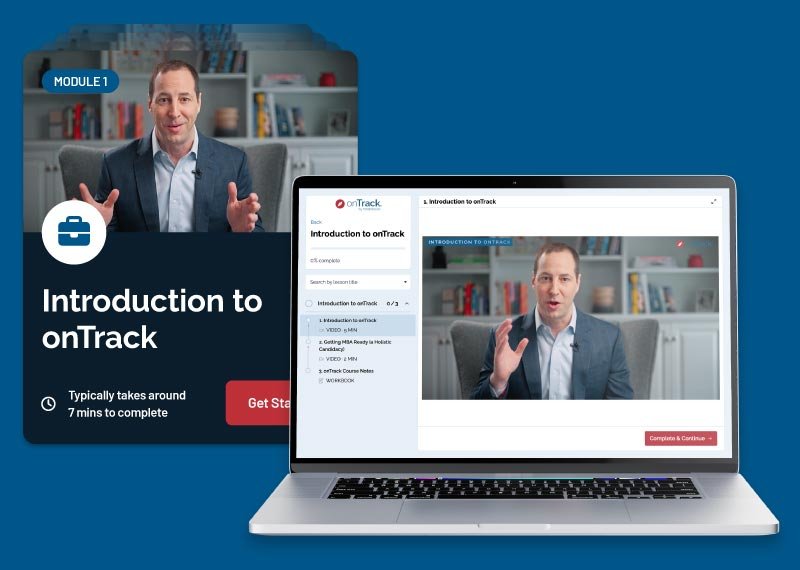
- Deep-Dive School Research: Evaluate schools using multiple criteria beyond rankings. Consider factors like culture, location, specializations, career services strength, and post-MBA employment reports. Resources like mbaMission's 8 criteria, Insider’s Guides, and the OnTrack platform can be invaluable. Attend online webinars, virtual tours, and network extensively with current students and alumni to get authentic insights. Aim for 5-7 target schools, including "stretch," "on target," and "confident" options.
- Clarify Your Career Goals: Admissions committees want to see a clear vision. Articulate your short-term and long-term post-MBA career goals. This ensures your target programs align with relevant academic specializations and employer recruitment pipelines.
- Map Your Application Strategy: Note submission deadlines and rounds (most programs have 3 standard rounds). Applying in Round 1 may offer an advantage, especially for applicants from "overrepresented" backgrounds, as it often allows you to secure a spot before many offers are extended.
Phase 2: Three to Six Months in Advance – Crafting Your Story
With your foundation set, it’s time to start developing the narrative of your application.
- Essays are Your Voice: Essay questions are typically released in May or later. These are your opportunity to explain your motivations, experiences, and future aspirations. Brainstorm compelling stories, create outlines, and revise multiple times. Focus on brevity, clarity, and simple language that genuinely reflects you.
- Choose Your Recommenders Wisely: Identify the required number of recommenders (often your current manager for the first). Plan when to solicit their support, giving them ample time. If you cannot get a recommendation from your direct manager, plan how to explain this deviation from school preferences in your optional essay. These crucial third-party perspectives provided by individuals with professional interaction with the applicant carry significant weight.
- Refine Your Resume/CV: Tailor your professional overview specifically for business school. For applicants with less than ten years of experience, a one-page resume is recommended. Highlight accomplishments using action verbs and quantifiable results, along with your education, leadership experiences, and community involvement, always adhering to school-specific requirements.
Phase 3: Zero to Three Months in Advance – The Final Push
This is where all your hard work comes together. Meticulous execution is key.
- Master the Application Form & Short Answers: Most online applications are released mid-August. Fully review every section. Draft responses to short-answer questions (e.g., career goals, professional positions, reasons for leaving) in a word processor first to easily manage character limits and ensure spell-check. Be prepared for potential video submissions, which some schools use as an additional qualitative assessment tool.
- Empower Your Recommenders: Enter your recommender information into the online portal, triggering the school's request. Provide your recommenders with specific details, a copy of your resume, and a memo highlighting your key achievements, skills you want emphasized, and how the MBA fits into your career plan. This helps them write strong, specific letters of advocacy.
- The All-Important Final Review: Before hitting submit, reread and review all application components multiple times. Check for consistency in your narrative, compelling storytelling, typos, and misspellings. Ensure the application fully represents your qualifications, potential, and "fit" with the school's culture.
Post-Submission – The Interview Stage
If your application stands out, you'll receive an invitation for an interview.
- Prepare for Success: Review common MBA interview guides, practice answering typical questions (e.g., "Why an MBA?", "Why our school?", "Tell me about a time you failed"), and conduct mock interviews. Stay current on school information and recent faculty research or student initiatives to discuss your fit authentically, without sounding overly rehearsed.
Industry Expectations: When an MBA is a Must-Have
Your target industry significantly influences the ideal timing for your MBA. Some fields view it as non-negotiable for leadership, while others prioritize practical experience.
- MBA-Favored Industries: Fields like consulting, investment banking, private equity, brand management, and increasingly, healthcare management, often make an MBA a critical credential. In these sectors, pursuing an MBA at an earlier stage (e.g., 2-5 years of experience for a full-time program) can be a direct pipeline to desired roles.
- Experience-Driven Industries: In sectors like technology, creative fields, or certain areas of entrepreneurship, hands-on experience, technical skills, or a proven track record might be prioritized over formal business education. Here, an MBA might be pursued later in your career, perhaps as a senior leader looking to transition into a general management role or launch a new venture, rather than as a junior professional. Online MBA programs, offering flexible options for professionals to balance work, education, and personal commitments, are particularly popular in these contexts.
Understanding these industry nuances is crucial for aligning your MBA timeline with your specific career aspirations.
Dispelling Common MBA Timing Myths
Let's debunk a few persistent myths that can cloud your judgment regarding MBA timing:
- "I'm too old for an MBA." Absolutely not. While full-time programs tend to have younger averages, online and executive MBAs cater to seasoned professionals. As seen with Kelley Direct, the average age is 32, with students spanning well into their 40s and 50s. Your experience is an asset, not a liability.
- "I need exactly X years of experience." There's no magic number. Programs look for quality of experience, not just quantity. A candidate with three years of impactful leadership in a startup might be more compelling than one with seven years in a stagnant role.
- "I must do a full-time MBA right after undergrad." This is rarely the ideal path. Most top MBA programs require at least 2-3 years of post-undergraduate work experience. The value of an MBA is maximized when you have a professional foundation to build upon.
- "An MBA is only for career changers." While many use an MBA for career pivots, a significant number use it for career acceleration within their existing field or company. The program helps them climb the leadership ladder.
Your Next Steps: From Reflection to Action
The Ideal Timing for an MBA isn't a universal timestamp; it's a personalized calculation that balances your professional trajectory, personal readiness, and strategic planning. You've now seen that it requires more than just meeting a minimum work experience threshold – it demands clarity of purpose, financial preparedness, and a strong commitment to the rigorous application and academic process.
Take the time to honestly assess where you stand on each of these fronts. Are your career goals crystal clear? Is your financial house in order? Are you prepared for the intense demands of an MBA program? If the answer to these questions is a resounding yes, then the time is likely right for you to embark on this transformative journey. Start by researching specific programs that align with your aspirations, begin preparing for standardized tests, and map out your application timeline. The sooner you start planning, the smoother your path to an MBA will be.